


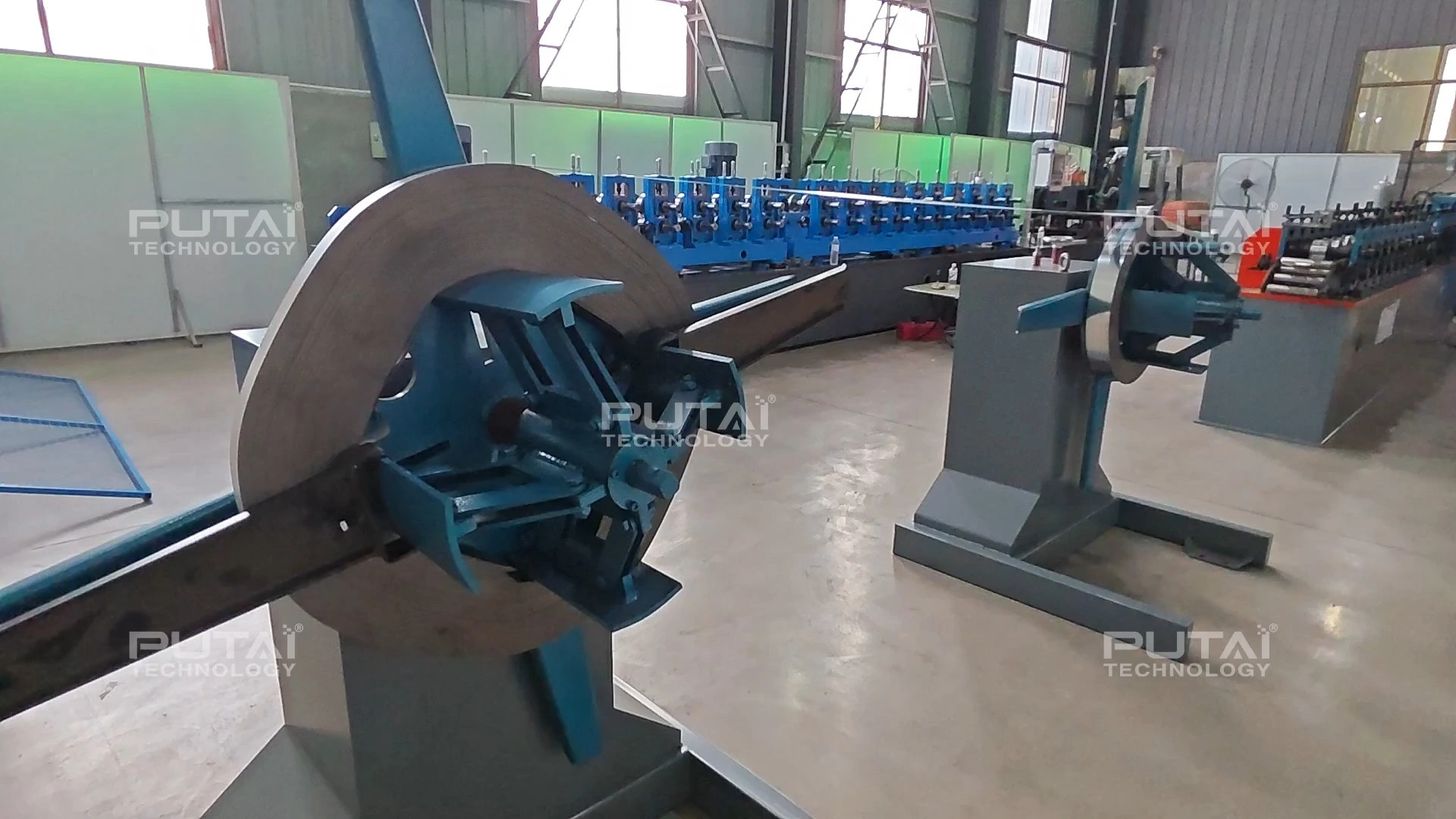
Putai Ceiling T Grid Roll Forming Machine for Suspended Ceiling Grid Production
What Is a Ceiling T Grid Roll Forming Machine?
The ceiling t grid roll forming machine is a fully automatic, PLC-controlled system engineered to manufacture the T-shaped metal framework of modern suspended ceiling systems. Built for high-volume building-materials manufacturers, this equipment continuously converts galvanized steel or pre-painted steel strip into main tee, cross tee and wall angle profiles with tight dimensional tolerance and a burr-free surface. Because the line integrates decoiling, levelling, punching, forming and cutting in one synchronized sequence, it is also the natural core of a complete suspended ceiling production line for factories supplying commercial ceiling contractors.
Unlike general-purpose roll formers, our design adds servo tracking shear, online punching and automatic stacking, so one operator can supervise the entire t bar ceiling grid machine from coil loading to finished bundle. Output reaches 40 m/min with profile straightness controlled within ±0.5 mm per metre — performance that directly reduces installation complaints on site.
Technical Specifications
| Parameter | Standard specification |
|---|---|
| Material | Galvanized steel, pre-painted steel |
| Material thickness | 0.25 – 0.50 mm |
| Coil width | 100 – 180 mm (customised to profile) |
| Forming stations | 14 – 18 stations |
| Forming speed | 25 – 40 m/min (variable frequency) |
| Main motor power | 7.5 kW |
| Hydraulic station power | 4.0 kW |
| Cutting method | Servo tracking hydraulic shear, ±0.5 mm cut-length accuracy |
| Control system | Siemens / Mitsubishi PLC with 7-inch HMI touch screen |
| Drive type | Gearbox or chain drive |
| Roller material | GCr15 bearing steel, HRC 58–62, hard chrome plated |
| Machine dimensions | Approx. 9,500 × 1,200 × 1,500 mm |
| Power supply | 380V / 50Hz / 3Phase (customisable) |
How Does the Machine Work?
The suspended ceiling production line follows a continuous, fully automated sequence:
1. Decoiling – a hydraulic decoiler (3T or 5T optional) feeds the steel strip under constant tension.
2. Levelling and guiding – a precision leveller removes coil set and keeps the strip centred.
3. Roll forming – the strip passes through 14–18 progressive stations and is gradually bent into the T-profile shape.
4. Punching – an online hydraulic unit creates the connector slots and holes needed for cross-tee interlocking.
5. Servo cutting – the servo tracking shear cuts to the programmed length without stopping the t bar ceiling grid machine.
6. Stacking and packing – finished bars are collected by an auto-stacker and bundled for shipment.
Every stage is synchronised by the PLC, so length changes and batch settings are completed on the touch screen within seconds — one of the reasons the suspended ceiling production line needs only a single trained operator per shift.
Which Profiles Can One Machine Produce?
A single ceiling t grid roll forming machine platform can be configured for the entire suspended-ceiling family:
1. Main tee (main runner): 38 × 24 mm, 32 × 24 mm, 24 × 24 mm — the load-bearing member suspended from the slab by hanger wire.
2. Cross tee (intermediate tee): 26 × 24 mm, 24 × 24 mm — clipped between main tees at 600 mm or 1,200 mm centres.
Where Are the Finished Ceiling Grids Used?
Profiles made on this ceiling t grid roll forming machine are installed in commercial and institutional suspended ceiling systems worldwide — office towers, shopping malls, airports, hospitals, schools and data centres. The finished grid carries mineral fibre acoustic tiles, gypsum boards and metal ceiling panels, and forms the standard supporting structure for the 600 × 600 mm and 600 × 1,200 mm ceiling module. Because the suspended ceiling production line delivers consistent slot geometry, contractors benefit from faster clip-in installation and a flatter finished ceiling plane.
FAQ
1. What is the typical delivery time?
45–60 working days after deposit, depending on the final configuration and tooling set.
2. Can one machine produce both main tee and cross tee?
Yes. Modular tooling and an adjustable punching die allow several profiles to run on one base frame, which is why many buyers choose our equipment instead of two separate lines.
3. What information do you need for a quotation?
Profile drawing or physical sample, material thickness, required production speed, and local voltage and frequency.
4. Is the t bar ceiling grid machine difficult to operate?
No. The HMI stores all recipes, so one trained operator can run the full line, adjust cut length and switch profiles from the touch screen.
5. Do you provide overseas installation?
Yes — on-site commissioning by our engineers or complete remote guidance, both included in the service package.
Tianjin Putai Technology