


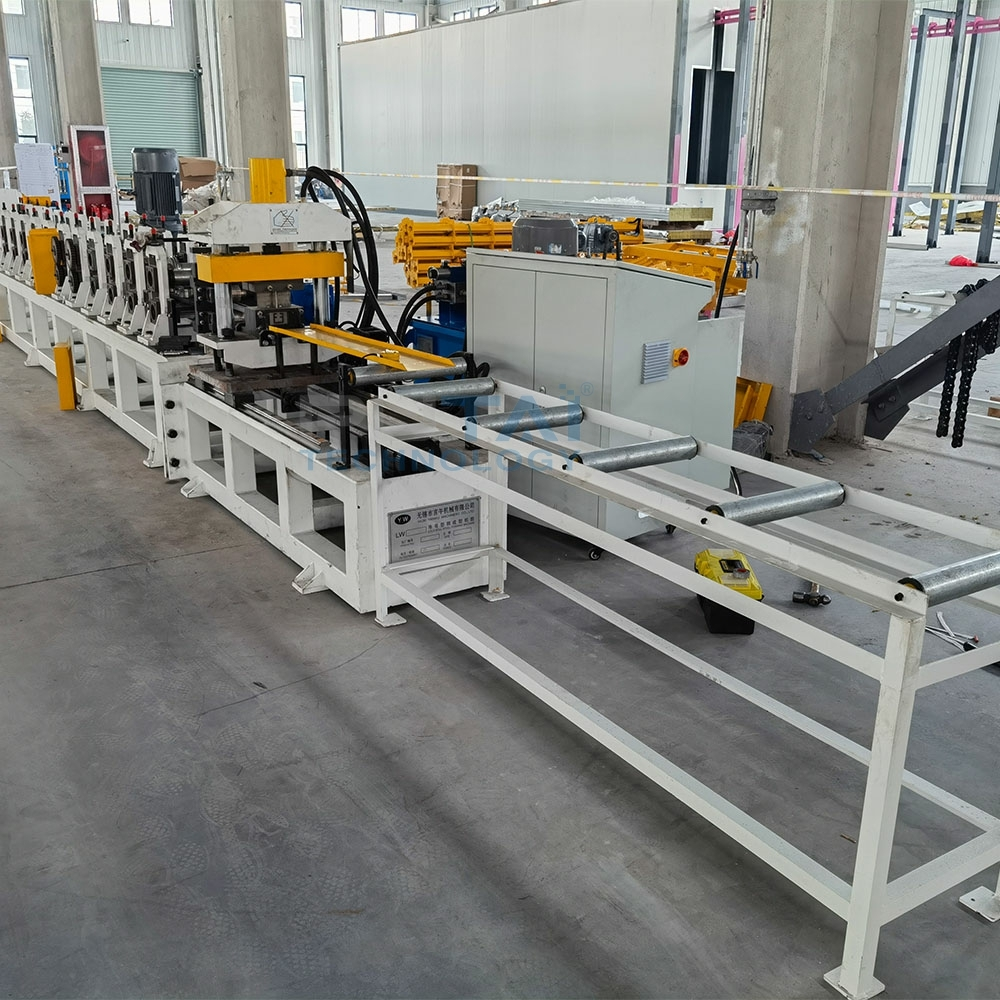


Putai Rack Beam Roll Forming Machine for Pallet Racking Shelf Production
Rack Beam Roll Forming Machine
A pallet racking system is built from three parts: uprights, beams and shelf panels. Most roll forming suppliers build the upright line and stop there, then buy beams from a third party. This rack beam roll forming machine covers the second part of a storage rack roll forming line.
A rack beam carries the load between two uprights, so it is a different problem from the upright itself. The section is either a closed box or a step profile, the ends need connector hooks punched into flat strip before forming, and the cut length has to match the clear span between uprights. That is why a beam line is not an upright line with a different roller set.
What a Rack Beam Line Does
Three things separate a beam line from a column line.
First, the profile. An upright is an open C or sigma section that the beam clips into. A beam is either a closed rectangular box or a step beam with a load-bearing lip. Closed sections need a different forming sequence and a different set of rollers, because the strip has to close on itself.
Second, the end connection. Beam ends carry three or four hooks that lock into the upright slots. Those hooks are punched into the flat strip before it is formed, not after. Punching after forming cannot reach the closed
section, and the hook geometry would distort.
Third, the length. A beam is cut to the clear span between uprights, so the cut-to-length accuracy directly decides whether the rack assembles on site. This is the reason the line uses servo cut rather than a fixed die.
Beam Profiles We Form
The line handles the three beam types that cover most pallet racking:
1. Box beam — a closed rectangular section with a welded or riveted end connector. Used where the load is heavy and the span is long.
2. Step beam — an open section with a step that carries wire mesh decking or shelf panels. The step has to be formed to a consistent height, otherwise the decking sits unevenly.
3. Lipped / angle beam — the lighter section used on shelving and light-duty racking, where the beam is bolted rather than hooked.
If your storage rack beam has a hook pattern that is not standard, send the end drawing. Hook pitch and hook count are set by the punch tooling, and that tooling is made per profile.
How the Line Runs
Decoiler → leveler → servo feed → punch press → roll forming → cut to length → run-out table
The punch press sits before the forming stations. Hooks, bolt holes and service holes are all punched on flat strip, where the tooling has open access to both faces. The formed section then passes through the stations
untouched.
Coil handling, punching and forming run as one continuous cycle. The line stops only for coil change and tooling change, so output is set by line speed and by how often you change profiles.
For a factory running more than one beam width, the practical question is whether to buy one line with changeable rollers or two dedicated lines. Changeover time and the number of profiles you actually sell decide that, not the machine price.
Specifications
The line is built on the same frame and control platform as our storage rack upright line. Beam section, strip thickness and station count are set per profile, so they are quoted together with your drawing rather than fixed in advance.
| Product name | Rack beam roll forming machine |
| Machine type | Pallet racking beam line |
| Line size | 9m*1.5m*1.5m |
| Material Thickness | 1.5-2mm |
| Roller material | Gcr15 |
| Shaft material | 40Cr |
| Control system | PLC |
| Automatic grade | full automatic |
| Roller stations | 18 rows |
| Shaft diameter | 70mm |
| Productivity | 20m/min |
| After-sales service | One year |
FAQ
1. Can one line make both box beam and step beam?
Only if the roller set is changed. The two sections need different forming sequences, so treat them as two tooling sets on one platform.
2. Do you punch the hooks or do we weld the connectors?
Both routes exist. Punched hooks are formed from the strip itself; welded connectors use a separate end piece. Tell us which one your design uses.
3. What is the maximum beam length?
It is set by the run-out table length, not by the forming stations. Longer tables are quoted per project.
4. Do you supply the upright line as well?
Yes. Upright and beam are usually bought together, because the hook pattern on the beam has to match the slot pattern on the upright.
5. What do you need to quote?
A profile drawing with the section dimensions, the hook or connector detail, the strip thickness and the beam length range.
Tianjin Putai Technology